Choosing plants with future climate in mind
Future horizons test the robustness of a choice. They describe projected climatologies, not the exact weather at a garden on a future date.
The idea at a glance
Three global warming pathways
20-year averages relative to 1850–1900. Points show best estimates; bars show very likely ranges (5–95%).
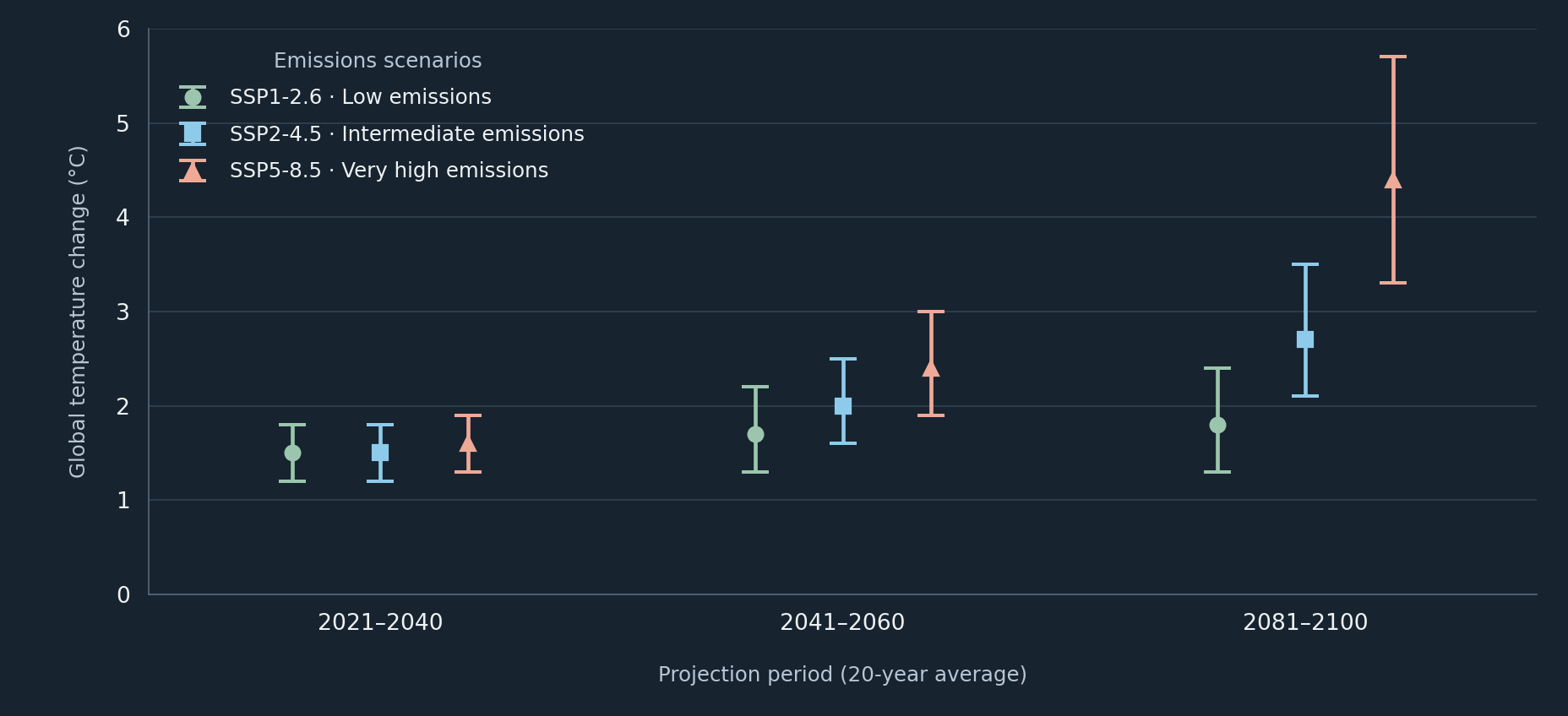
Chart data and uncertainty ranges
| Scenario | 2021–2040 | 2041–2060 | 2081–2100 |
|---|---|---|---|
| SSP1-2.6 Low emissions | 1.5 [1.2–1.8] | 1.7 [1.3–2.2] | 1.8 [1.3–2.4] |
| SSP2-4.5 Intermediate emissions | 1.5 [1.2–1.8] | 2.0 [1.6–2.5] | 2.7 [2.1–3.5] |
| SSP5-8.5 Very high emissions | 1.6 [1.3–1.9] | 2.4 [1.9–3.0] | 4.4 [3.3–5.7] |
Several horizons
2035, 2050, 2070 and 2100 reveal a trajectory rather than a single snapshot. A taxon that remains stable through time is less fragile than one that quickly approaches a climate limit.
Several scenarios
Scenarios explore different trajectories. The medium scenario is a useful reference, while the spread between scenarios indicates how sensitive a decision is to climate assumptions.
Building a robust choice over time
Trend, not certainty
Climate models contain uncertainty. ClimaFlora uses projections to compare magnitudes and directions of change without claiming year-by-year precision.
Match horizon to lifespan
An annual and a long-lived tree do not share the same exposure time. The longer the expected life of the planting, the more relevant the future trajectory becomes.
Choose robustly
When several taxa work today, favouring those that remain compatible across multiple horizons and scenarios can reduce future replacement risk.